Showing posts with label New Orleans. Show all posts

Tuesday, February 20, 2018

Introducing Liz Bruce

A Note From Augustin J Correro, Co-Artistic Director & Sometimes-Blogger
Hey, TWTC Family!
The last year has been a whirlwind at TWTC, and we've fallen behind on blogging. We're growing so fast and producing theatre is no small feat. That's why we've recruited help to be sure we're still turning out quality content! Please join TWTC in welcoming Liz Bruce as a contributing blogger!

Why Tennessee Means NOLA To Me
by Liz Bruce, M.A., M.F.A., Contributor
I wasn’t born in New Orleans, but the city began bewitching me at an early age. That bewitchment, I owe primarily to Tennessee Williams. I remember it clearly: assigned to read The Glass Menagerie for English class, I found myself captivated by the visceral, vibrant words that Williams wrote. I quickly checked out a Williams anthology from the school library and was soon swept away by this far off land where such lovely, dark, and tumultuous things happened.Williams made sure I knew that New Orleans was special.

Years later, when my now-husband gave me my first physical introduction to his native New Orleans, I felt some trepidation. Being from New York, I was raised with the snobbish attitude that New York City is the center of the entire world; no other city could possibly compare. What if New Orleans failed to live up to the myth Williams had given me? 

I needn’t have worried. It was a warm day when I drove into New Orleans, and as my AC was broken, I had the windows rolled down. A favorite song of mine was playing on the radio as I pulled up to an intersection, and I was dancing to it, blissfully unaware, caught up in my groovy tunes. From the next car over, a peal of laughter rang out, and I turned, ready to be embarrassed, but the driver simply cheered and started dancing along with me. There we were, strangers stopped at a red light, having a dance party, sharing in a moment of unadulterated joy. Just like that, I was hooked. This was my city.


I moved to New Orleans about six months ago. As a newly minted and proud transplant, standing on the brink of my first Mardi Gras season, a celebration enhanced by the advent of the tricentennial, I’m finding New Orleans a home I didn’t know I was looking for, and I sometimes can’t fathom why anyone would choose to be anywhere else. In this, I feel a particular kinship with that other transplant, Tennessee Williams himself, who not only called New Orleans his spiritual home, but who also famously said, “America has only three cities: New York, San Francisco, and New Orleans. Everywhere else is Cleveland.”

Williams’s writings communicated New Orleans to a broader world in a way that continues to reverberate from the heart of the city outward. His homes and haunts occupy many corners of the city that can still be discovered today. The madness of a boarding house landlady in Vieux Carré comes from Williams’s own demented landlady. The famous Desire streetcar route ran right past William’s St. Peter Street apartment, and Williams’s favorite bistro, Galatoire’s, makes a brief appearance in Streetcar, with Stanley declaring vehemently that he isn’t going there for supper. 

But Williams’ writing allowed outsiders to know the streets in a way that moved beyond its geographical points of interest. Williams’s descriptions of New Orleans, often found in his detailed stage directions, invite audiences to feel, to smell, to hear: In the opening of A Streetcar Named Desire, for example, Williams describes the “raffish charm” of the poorer neighborhood, the lyricism of the sky, the faint smell of bananas and coffee, and the ever-present sound of, “a tinny piano being played with the infatuated fluency of brown fingers. This ‘Blue Piano’ expresses the spirit of the life which goes on here.”

Williams moved to New Orleans when he was 28, and there found an escape from a troubled family life and a puritanical past. In New Orleans, Williams found safety and freedom as he had never experienced before; he found a sacred slice of bohemia where artists, adventurers, and lovers could live unfettered. Williams referred to New Orleans as a “vagabond's paradise” and remarked, “In New York, eccentricities, authentic ones, are ignored. In Los Angeles, they’re arrested. Only in New Orleans are they permitted to develop their eccentricities into art.” New Orleans was a place where William’s creativity and individuality would not only be nurtured, but celebrated. 

Certainly, a defining characteristic of this safe haven was New Orlean’s position as a singular bastion of sensual fantasy and permissiveness, set apart from the rest of the world. It was in New Orleans that Williams selected homosexuality as his, “sexual way of life.” Williams himself even told the story of losing his virginity to a sailor who climbed up his fire escape from a party below. New Orleans spoke in daylight what was too often whispered in darkness, and that suited Williams just fine.

Williams’ words painted a picture of New Orleans that was at once cosmopolitan and decaying, a city of glorious contradictions and tangles of difference. New Orleans was a place where the senses were titillated, awakened, and sometimes even assaulted. It was an intermingling of races, sexualities, celebrations, and sometimes despair. For Williams, this churning mess of spirit and flesh was what he needed.
Spirit and flesh continue their dance in the streets of New Orleans today, something that I like to think would make Tennessee Williams proud. His legacy continues to spread the good news of this strange, wonderful city to the wider world, and New Orleans in turn does its part to keep his legacy alive, through productions of his plays and celebrations of his life and work. 

In all that Williams has said of New Orleans, my favorite is a simple sentence from his journal: “Here surely is the place I was made for if any place on this funny old world.” 

I don’t think anyone could have said it better.


Hey, Gang! It's Augustin again. Don't forget to grab your tickets to One Arm by Moises Kaufman, adapted from the short story and screenplay by Tennessee Williams, opening March 22 in collaboration with the Tennessee Williams/New Orleans Literary Festival! On Saturday, March 24, there'll be a conversation with Mr. Kaufman facilitated by me and the New Orleans Advocate's Bradford Rhines! Just click the image below and reserve your seats now!

Tickets Now On Sale!

Sunday, April 9, 2017

Coloring Classics

Actors, Casting, Race, and Tennessee Williams

by Augustin J Correro

This Blog Post Is Equipped with Three Disclaimers and a Trigger Warning for Everyone’s Safety.

Trigger Warning: This post contains one writer’s ideas regarding theatrical production in regards to race, racial symbolism, and other race-and-ethnicity-centered topics. It centers around casting, concept, and actors.

     In Rodgers and Hammerstein’s The King and I, there is a ballet in the second act performed by Siamese characters that depicts the story of the “Small House of Uncle Thomas”. The story is adapted by the dancers from Harriet Beecher-Stowe’s 19th century novel Uncle Tom’s Cabin. The selection of this particular story as is a tribute to the King’s children’s governess Anna, a white English woman. The anti-slavery message is pointed, but in The King and I, as is the case in so many classics, the colonial white savior comes to teach a valuable lesson to the less “evolved” characters. The result is that the message may be delivered in a way that isn’t most effective.
American Slavery, as explained by Siamese dancers,
as told by Rodgers & Hammerstein
     But what if Anna is a black actor? Does her place as the symbol of the savior-teacher mean something else (something more?) if she’s not white? Can it? Must it?
     Examining to another classic, what happens if Romeo and Juliet is cast primarily (or entirely) with Latinx actors? While it can change the meaning of the production, must it? Can it not? Does it have to? Is it different for each audience member?
     Theatre makers make several considerations when it comes to casting, play selection, hiring, and staging. Sometimes symbols get lost—especially in classics in which the symbols can easily be taken for granted. As you might have guessed, it’s no different for Tennessee Williams. This essay attempts to scratch the surface of the topics of race and ethnicity in casting and producing the plays of Tennessee Williams.

     A conversation has been ignited in New Orleans regarding the place of black bodies in Williams’ plays, and the place of Williams’ plays in a world where the value of black bodies has increased exponentially since the plays were written. I can think of no better setting for this conversation than in New Orleans. Recently, I enjoyed a panel discussion prior to Southern Rep Theatre’s production of Sweet Bird of Youth which explored this topic in detail. A panel of all African-American writers described their connections to the universality of Williams’ work while also negotiating the sensitivities of racially diverse casting and a lack of in-written black characters in classic plays (The panel description can be viewed midway down the page here). While some of the opinions expressed might be unpopular, this writer and theatre-maker agrees that the conversation must be explored. For various reasons, I will not be discussing the symbolism in that specific production of Sweet Bird, but will instead pose several “what-if” scenarios from A Streetcar Named Desire.

First Disclaimer: The White Man Has a Head Start
It is worth stating that white actors have a massive advantage in regards to the availability of roles in theatre, film, and television. This is because the dominant voices in storytelling have been white for centuries in Western Civilization. Naturally, those white storytellers write white characters. The same is generally true for male writers writing stories which primarily concern men. It is something theatre-makers should be conscious of, although there is no one monolithic solution to inequity in opportunity. It’s absolutely true of Tennessee Williams, but rather than throwing the baby out with the bath water and stopping production of Williams altogether, we choose to continue producing Williams plays with this conundrum as a consideration. Ergo, if we wait around for more roles for actors of color to play, the gulf between them and opportunity will only continue to expand, since there’s such a wealth of white writing, and white writers will continue to tell their stories.

Second Disclaimer: 
The playwright in question was white. He tried as best as he could figure, as a moneyed white gay man in the mid-1900s, to represent the underrepresented. We therefore assume for the purpose of this essay that any racist ideals he ascribed to were not purposeful or malicious, and that he was not in fact the Grand Wizard of the Ku Klux Klan. There is evidence of a continually evolving racial and cultural understanding in his published and unpublished writing.

Third Disclaimer:
This writer is also white, so ¯\_(ツ)_/¯  

Terrence Howard & James Earl Jones in Cat on a Hot Tin Roof

So How Do We Inject Actors of Color Into Classics?

An oversimplification would be, “you just do”. However, there are some pitfalls when you are faced with two devices: stunt casting and problematic symbolism.

Stunt casting is rarely the actor’s fault. It’s usually a tool by a director or a producer in order to jar audiences into buying tickets. Stunt casting is when an actor is selected not because they’re right or ideal for the role, but because they’re popular, or might be incendiary, or for some other unartistic rationale not rooted in the text. Think of a community theatre production of A Streetcar Named Desire where the local grande dame and president of the Ladies’ Auxiliary at age 45 is selected to play Blanche—or worse, Stella. That’s stunt casting. It’s sin is obliviousness or willfully ignoring the problems it creates.

Symbolism is more nuanced—it’s trickier to sort out when it’s an issue. Sometimes, it’s not. There are plays which don’t use symbolism, in which case, the race of the actors really has no repercussion on the story. Of course, it’s good to be sensitive that the only black character isn’t a villain or a minstrel-type character, or that the only woman isn’t a loose floozy, or that the women don’t talk to one another exclusively about men (see: Bechdel Test, flawed but a point of interest). However, while it’s easy to mistake Williams for a steadfast realist, considering wide-release films and traditional stagings would convince audiences of that misconception, Williams used symbolism. He used symbolism a lot—and often the symbols were bodies onstage.


Problematic symbolism happens when the semiotics are ignored or are socially irresponsible. Semiotics is defined as the study of signs and symbols and their use or interpretation. It is a realm of considerations which must be carefully examined, even if they could be easily overlooked. So: The entire cast is white except for Stanley and the Negro Woman. Even the Mexican woman selling flowers is a white woman (oops!). But then Stanley rapes Blanche, meaning that literally the only black man in the story is a rapist. This is a challenge for the director to work through before making this choice. Here’s why: if there is a dominant social narrative which is supported by the story being told onstage, but which is an unjust narrative, choices should be reconsidered. The dominant social narrative here is that black men are a danger to white women, that they are rapists, ill-bred, crude, and trifling (i.e., they will have sex with you and your pregnant sister, whether you like it or not). Because this is a dominant social narrative for large swaths of the country, the producer either feeds the unjust narrative, or doesnt: it can’t be neither. Stanley as a symbol represents a new world order which is both tender and overpowering, and this gets lost if he literally represents the fear white women have of virile black men.

So Where Does That Leave The Brilliant Actor I Want To Play Stanley?

Do we just not cast this guy because we’re afraid of the implications of a black male body committing rape? Well, no. This is where color-conscious casting comes into play. Color-conscious casting is not the same as color-blind casting. The latter operates on a defunct assumption that race means nothing to anyone, and that there are no implications of different colored bodies in different spaces. It sounds great, but it doesn’t really function. Even if the person casting decides it’s color-blind, that doesn’t mean that the audience or the actors involved share that color-blindness.
Color-conscious casting is much more complex. It’s casting with the understanding that there are implications to the choices as well as a separate, unequal pool of opportunities for actors of color, and choosing to craft and aesthetic and execute a production with that in mind. Again using Streetcar as an example, I am made to recall the 2012 Broadway production directed by Emily Mann starring Blair Underwood and Nicole Ari Parker. While Blanche, Stanley, and Mitch were black, Stella and other members of the cast were of various skin tones and racial and ethnic origins. This meant that Stanley was not the only black body, and that the heroes were not uniformly white.
Blair Underwood and Nicole Ari Parker in A Streetcar Named Desire

Common Producer Complaint: But Actors of Color Just Don’t Come Out!

This is a serious challenge for producers. Even Broadway productions have to make pointed efforts to invite and entice actors of color to show up for auditions. The summit of theatre arts has been long painted out of reach for communities of color, so there’s work to be done. 
What should be undone is the snarl of ideas that historical precedent and historical accuracy are valid reasons to bar bodies of color from opportunities. 
We as theatre-makers should do as much as we can to see the work of artists of color, whose platforms might not be as prominent as white artists. You may even have to go where black, brown, red, and yellow people are. The next step is to cast who is best for roles, period. From time to time, this may mean casting someone who is talented and right for the role who has a small skills gap. If it means that your director must work more to give an actor of color some additional coaching because he/she/they didn’t get to go to theatre camp each summer, it may be what needs to happen to reflect the community in which you’re presenting the work. 

It’s Not All Bad News, Though.

Recently, I read an article, the title of which was misleading: For the First Time Ever an Asian-American Has Been Cast in a Classic Tennessee Williams Role. It reads, "For the First Time Ever an Asian American Has Been Cast in a Classic Tennessee Williams Role".
LaKesha Glover in Small Craft Warnings. Photo by Ride Hamilton
At first sight, this would imply that no Asian-American ever has been cast in any iconic Williams role. Upon reading the article, it’s only about Maggie Pollitt in Cat on a Hot Tin Roof. Either way, it’s a step in the right direction. TWTC’s production of The Rose Tattoo Featured an actor of Thai descent as Serafina Delle Rose in 2016. In 2015, Small Craft Warnings featured two African-American actors in roles almost exclusively ever played by white actors: they were messy characters, but they were situated in a room full of otherwise messy characters (i.e., the full burden of being violent, loud, and flawed didn’t fall summarily on the backs of the black folk).

People are symbols in Williams. There’s a responsibility that comes with storytelling and wielding symbols. Race and color do carry meaning. These three facts are intertwined, and should be handled with same same care as any other aspect of a production.


In summary, if we expect plays by Williams to be exalted in the same way as plays by Shakespeare, which I think they deserve, the doors to a multicultural society of actors, designers, and storytellers must be open so that they can lay hands on his plays. Williams’ plays are American. Now America is changed—the lens through which we view her playwright’s theatre must be checked and adjusted from time to time.

Monday, November 7, 2016

Dangerous Ladies (If They Need To Be)

Women Who Win in Williams

by Augustin J Correro

  In one of Tennessee Williams’ most famous plays, Maggie ponders the titular question: “What its the victory of a cat on a hot tin roof?” She muses “…Just staying on it, I guess, as  long as she can…” The notion of survival as a kind of victory reoccurs in Williams’ plays. It’s a sometimes cynical, sometimes encouraging idea: when faced with a world that designates us all as fugitives in our own skins, to get out of bed each day and confront the ambivalent old universe takes courage and gumption. The victory is elevated when we overcome severe circumstances and insurmountable foes. Williams smashed his characters’ backs against walls which, like a booby trap in an arcane temple, inched closer and closer to the ledge of the abyss. His characters are made to chose between leaping into oblivion or clawing up the wall. No characters are faced with more unbeatable odds than the three women who headline the one acts in our current production, Tennessee Williams: Dangerous Birds (If Agitated). When it comes to uphill climbs, these women scale Everest. 
One such indomitable character is Miss Sylvia Sails in Sunburst, a retired actress who has recently suffered a stroke, and has holed herself up in a hotel room to lick her wounds. After a couple of days, the buzzards begin to circle. A pair of devious young crooks admit themselves into her suite one night and hold her captive. Their singular focus is the Sunburst Diamond on her finger, which they unhappily learn is stuck on the digit. As they plot ways to dismember Miss Sails without stirring suspicion, she allows them to succumb to their own foolishness, and stalls them until escape is possible. In the broadest strokes, Miss Sails overcomes her plight by letting the criminals wear themselves out. Even when immobilized, helpless, and endangered, she exhibits poise, patience, and cunning to avail herself of the situation.
The diamond on the finger could easily be compared to Williams’ own fortune and fame, which became the object of concern for multitudinous hangers-on later in his life. Perhaps what he was indicating in this text is that while he may have appeared to be easy pray for sycophantic ne’er-do-wells, he wasn’t a sitting duck. 
Another powerhouse femme fatale featured in Dangerous Birds is Queen May in The Pronoun “I”. This rarely staged piece for the lyric theatre looks nothing like most viewers’ perceptions of Williams’s theatre. It takes place centuries ago and centers on an aging, despised queen who is considered to be a maniacal despot, simply for having up-ended the patriarchy. She chooses her sexuality over the demands of others, and soon enough there are pitchforks and torches at the palace gates. She boldly, even ironically stares down her adversaries with a fatalistic wit, and through cunning and ruthlessness manages to come out on top (literally and figuratively). It’s a striking reversal, but one might wonder if it be so surprising if it were a male character using similar traits to outwit his opponents.
With Queen May as a surrogate, Williams took a sledgehammer to the wall of expectations, pulverizing the idea that he needed to stay inside of a pleasant, predictable cell. He did so in this lyric piece, tinkering with both style and subject. Without spoiling the play, the chameleon act of Queen May could also be a greater metaphor for Williams’ ability to adapt to new challenges and cleverly dodge critical slings and arrows.
The most mystifying and metaphorical of the three women our night of plays chronicles is the bedraggled showgirl known only as the Gnädiges Fräulein. The symbolism in the play named after the hapless heroine has a life of its own. On its surface, the cartoonish burlesque deals with two women named Polly and Molly as they get stoned on the porch, are harassed by a menacing bird, and molest and marvel at the Fräulein, who is a tenant at Molly’s guesthouse. The comedy of this piece is entirely situational, since the characters are not much changed by its conclusion. Instead it feels like a hamster wheel of cruelty and slapstick.
The symbolism can offer insight, but isn’t a necessity. Breaking the characters down to their most basic desires, we see that Molly, the landlady who sells standing room to her rooming house and whose business focuses on quantity over quality is an obvious allusion to Broadway producers. Polly is a society reporter, so she obviously represents the press. With a little bending of the imagination, it’s not hard to see that the vicious Cocalooney Birds stand for social rabble who wish to gobble up rotten bits and pick on easy targets—a cynical view of the uninformed public, perhaps; and the character named Indian Joe is a sort of American ideal who is interested in nothing and who nobody can keep interested for long. So where does that leave our champion, the Gnädiges Fräulein?
If the showgirl is dependent upon the landlady, and the landlady is dependent upon the press, and both press and landlady have a symbiotic/parasitic relationship with the rabble. The showgirl, then, must represent the artist. Simultaneously, everyone is obsessed in one way or another with the ideal that is Indian Joe, but nobody can draw a bead on him. If this all seems complicated and heady, that’s because it is—and completely unnecessary to one’s enjoyment of the slapstick tornado that is The Gnädiges Fräulein. The poop jokes and sight gags more than prop this play up—they elevate it to high low comedy interspersed with poetic brilliance. If one wants to delve deeper, the metaphor can be further plunged, of course—the showgirl’s signature trick featured catching a fish in her jaws, a trick that the landlady demands she repeat several times a day. It speaks to Williams’ frustration with being expected to crank out brilliant reproductions of earlier plays for a general audience, or else be treated as a washed-up pariah. The woman is pecked over by the bird, ignored by the Indian, and treated as a pitiful novelty by the press. She endures repeated beatings and indignities, but even to the last moment, her fierce spirit refuses to be extinguished.
Hers is the ultimate victory of a cat on a hot tin roof. She stays on, long beyond expectation and reason, because to give up is to be defeated. The Fräulein, like the Queen and Miss Sails, obliterate the odds and press on. They defy the ambivalent universe and claim their victory against relentless adversity. While they’re not as often celebrated as Blanche, Maggie, or Amanda, these three ladies featured in Dangerous Birds are the epitome of the fighting, unflagging women Tennessee Williams idolized.
      Whether you come for low-brow fun, lofty metaphor, or a night spent watching an incredibly talented cast, join us for Dangerous Birds (If Agitated), and watch these women of Williams kick some cosmic ass.

Dangerous Birds (If Agitated) Now Playing through Nov 20
Friday - Sunday 8pm at Phillips Bar Uptown (733 Maple at Cherokee)

Photo Credits: Bunny Love as the Gnädiges Fräulein, Mary Pauley as Miss Sylvia Sails, & Abby Botnick as Queen May by Ride Hamilton / Abby Botnick & Pearson Kunz by James Kelley

Monday, March 28, 2016

World Premiere Tennessee Williams: How It's Possible

Our next production, Tennessee Williams: Weird Tales is an evening of delightfully bizarre one-act plays by America's Greatest Playwright. Two of these plays, Ivan's Widow and The Strange play have never before been staged. Very regularly we get asked by folks who haven't heard, "What's your next show?", and when we tell them that we're giving two Williams plays a world premiere, we're generally met with astonishment and the question, "How is that even possible?"

The question is asked so frequently that we thought it best to articulate it in a blog post, so the news and the details can reach even more people who are interested in Tennessee Williams' plays.

So much writing!
Tennessee Williams wrote a lot. It's probably safe to say that we have more of Williams' writing than any other significant American playwright. Between plays, short stories, poems, screenplays, and novellas, his body of work is considerable. However, if you count his collected journals, letters, notebooks, essays, and memoirs, there's even more to read about the playwright than you could have guessed (there are also paintings!). Williams wrote daily, prolifically, and compulsively. He left behind about as many clues as to his inner workings and his creative life as a person could. In an age before around-the-clock tweets and twenty-four-hour news, he was setting everything down on paper, providing future generations with a wealth of information about himself and his writing.

How do we have so many of these private clues?
So proud of her "writing son", the playwright's mother Edwina was as obsessive about collecting his work as her son was about producing it. From her collection, the writings found their ways into various archives, libraries, and collections. Draft after draft of famous Williams plays can be compared and contrasted, as he was dedicated to making every syllable count. His notes can be found  scrawled on the edges of typed sketches. They'e still pored over by dedicated scholars, dramaturgs, and lovers of Williams today.

But wait, there's more...
Williams didn't just leave behind previously produced, plays, though. There were also new ones — plays which had not been published or, in some cases, staged during his lifetime. In the three decades since his death at age 71, a number of Williams plays received their first performances, and TWTC is excited to be numbered among the companies given the privilege of staging the master's work for the first time.

En Avant!
Some of the plays premiered posthumously are from early in the author's career. The Strange Play (c. 1939) is an early, experimental work. Other plays such as Ivan's Widow (c.1982) showcase the playwright's mature, later-lifemusings. 

If you'd like to join us to toast our two never-before-seen Williams plays, Tennessee Williams: Weird Tales opens this Friday, April 1st in conjunction with the Tennessee Williams/New Orleans Literary Festival.

We'll see you at the theatre!


Photo Credits: (above) Alexandra Kennon in Ivan's Widow and Emily Russell in The Strange Play, photographed by James Kelley.

Monday, December 7, 2015

The "Shakespeare" Treatment

The Great and Challenging Aspects of Staging Classics

by Augustin J Correro


One of the main goals of a TWTC production is to share with the audience a performance that is unique and innovative. We purposefully aim not to restage films, since movies will always do movies better than theatre artists. We like to bend expectations and try new things. We believe that's what will help us to keep theatre relevant and living. The alternative to living theatre is artificial theatre: theatre as an artifact.

We have great reverence for artifacts, don't get me wrong. However, artifacts aren't something we're normally allowed to touch. Just the same, it's hard for artifacts to touch us from the inside of a glass caseand we're interested in theatre that touches people.

Somewhat often, audience members express a feeling of disconnection (of not being touched) when they see classics produced. Moliere falls flat for them, or Sophocles is less of a tragedy and more of a snooze. The folks that share this feeling with me express that they appreciate the plays, but that they really don't derive enjoyment from seeing them. One culprit for this kind of audience exclusion is expectation. Producers and artists alike have to grapple with the expectations of what plays might-or-should look and sound like, sometimes to the detriment of the experience. Whether it's austere Ibsen or fancy-schmancy Shaw, people have expectations about plays and playwrights, and they can be hard to shake.

Several of Tennessee Williams' plays are American classics. Naturally, they come with expectations (conventions like Southern belles wrestling with desire or families battling over inheritance). In addition to informing how the better known plays are staged, the TW classics dictate how the general public views the plays they're not as familiar with. For example, it's hard to find a review of a Tennessee Williams play that doesn't compare the play being discussed to Streetcar, The Glass Menagerie, or Cat on a Hot Tin Roof

In addition to fulfilling expectations set down by other plays, some productions of Williams' works seem to mimic conventions from previous stagings, giving the audience some approximation of what they might have come to expect. This creates even more stagnancy in how Williams' plays are staged. 

However, even though many productions err on the familiar side, others blow the lid off of those expectations. They challenge the expectations, toss off the conventions, and create unique iterations of the plays. For the audience, it really can go either way. It can be an absolute thrill to see a complete departure or a style of Tennessee they never expected, or it can be a blazing hot mess. 

When it comes to staging plays, there are those who would say "do it like it's been done before, always", or more pragmatically "give the people what they want". These are valid notions, but to illuminate the other side of the argument, I'd like to draw a comparison between Tennessee Williams and the other greatest English-speaking playwright: William Shakespeare.

There are die-hard purists in both the Williams and the Shakespeare camps, suggesting the actor doesn't breathe or blink unless it's in the script . There are also those who would yank the literary texts out of the library and burn the books, choosing only to stage the heart and soul of the plays, with no regard for the particulars. We at TWTC prefer a more measured approach than either of these, and we're not alone.


There are lots of factors which contribute to the "Shakespeare Treatment", where we universally acknowledge that something is "great", but when we go to see it or pick it up to present it, we can't figure out why it doesn't make us feel "great". It's also hard to express why to those around us because we're afraid to sound unsophisticated when we say "Shakespeare is over my head" or "Tennessee Williams is like grandma stuff". We can feel left out when we're told that Shakespeare is universal and that Tennessee Williams is the poet of the human soul, but that production with those good actors around that lacy table just wasn't our cup of tea. I've been there. Then I saw productions that changed my mind.

Some of the most thrilling iterations of Shakespeare that I've ever seen were reimagined, updated in terms of staging, or non-traditionally cast. Some of them were painstakingly staged to resemble the original productions but focused on the audience's understanding rather than showcasing the esoteric virtuosity of the performers. Either way works, as long as it's audience-centered. By treating Shakespeare's plays as living art, companies are able to engage new audiences, captivate existing ones, and challenge artistsall while respecting the text. Rather than pumping formaldehyde into the plays to preserve them at just below room temperature, these kinds of productions keep blood flowing to the heart and brain of theatre, keeping it alive, hot, and vital.

The same can be said of Williams' plays, and it's our hope that more productions will exhibit daring, innovation, and imagination. We've seen it work (we've seen it not-so-much work, too), and TWTC is committed to sharing new, unique, and enriched stagings with the New Orleans community.

Our upcoming production of Small Craft Warnings by Tennessee Williams features a diverse cast and is set during the holidays, present day. It's performed very close to the audience in a bar (the setting put down by TW in the script), and you can drink from the very same bar as the characters. These choices are all departures from previous productions, but were made with respect for the text and the audience. See how it makes you feel. We'll see you at the theatre!

Small Craft Warnings by Tennessee Williams
December 10-20, Thursdays-Monday. 8pm Weekdays, 7pm Saturdays & Sundays. 
Performed at Mag's 940 - 940 Elysian Fields (at Elysian & North Rampart)

Tickets can be purchased at www.twtheatrenola.com or by calling 504-264-2580

Thursday, November 12, 2015

Tennessee Around Town

TWTC’s Commitment to Our Community

As we gear up for our next show, TWTC wants to share some of the good work we’ve been doing offstage, too! We’re committed to engaging our community and sharing Tennessee with New Orleans and the surrounding area. If you know of a school or organization who would like to learn more, email info@twtheatrenola.com !

Students from Bonnabel High School in Kenner came to see Kingdom of Earth and were treated to a a special discount and got to partake in our first Talking Tennessee session before the show! Above are some of the students after the show with Sean Richmond, who played Chicken.

Co-Artistic Directors Nick and Augustin gave an informative talk about Tennessee Williams, A Streetcar Named Desire, and led a Q&A with students from Cabrini High School in New  Orleans!

Will Mr. Merriwether Return from Memphis? was FREE to anyone who wanted to attend, and was hosted by New Orleans Public Library. Pictured above, the show was performed outside on a perfect night for theatre on the lawn of Latter Library.


Look forward to more posts about TWTC in our community!

Wednesday, September 16, 2015

Public Indecency

Dispelling the High-Brow Tennessee Williams Myth

by Augustin J Correro


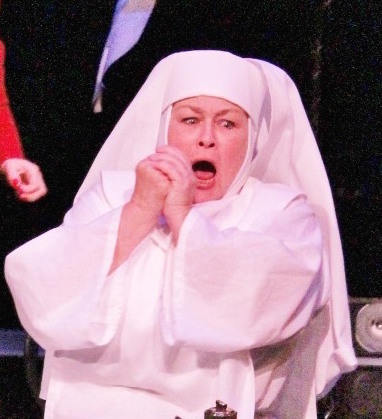
Cherri Golden as Sister Felicity in Suddenly Last Summer, Columbus MS Tennessee Williams Tribute
Photo Credit: Hope Harrington Oakes


There’s an ongoing joke between me and a director friend of mine. Chris Bentivegna, who is known in New Orleans for staging campy, knock-your-socks-off theatre events that often leave audiences busting guts and/or covered in fake blood, will at intermission to his shows glibly say to me “Well, it isn’t Tennessee Williams”. He knows this both tickles me and chafes just a little. 

Chris knows that Tennessee Williams is filled with varied and colorful humor alongside poetic pathos, yet our little joke does speak to a larger notion in the zeitgeist about the playwright: that Tennessee Williams’ plays are high-brow entertainment. I’d like to take the time in this post to dismantle that half-baked notion.

The Shakespeare Treatment
To begin, let’s examine another playwright whose work is viewed by some as strictly high-brow: William Shakespeare. At the risk of sounding indelicate, Shakespeare is the source of more penis, breast, and butt jokes than most playwrights in the English language. A kind of hyper-historical preservation of the author’s plays, however, has a chilling effect on the human warmth laid down in them. This isn’t to say that Shakespeare’s poetry is not poignant, or that he didn’t touch on much deeper truths in his drama. Instead, I posit that it’s both—and that without one, the other may suffer from a reputation closer to a relic than a living piece of art and literature.

Putting Shakespeare onstage as if it’s inside a glass case in a museum creates a degree of separation between the play and the audience. The same is true for Tennessee Williams. If the primary concern in a production is replicating what the play “ought to be” based on prior productions or academic correctness, there’s an increased likelihood of a flat, dull production. A viewer may not be able to place why he or she isn’t moved by the production, but it’s very possible that he or she will feel “left out” of the conversation. Rightly so: the museum glass case prevents touching from happening.

Thanks to the efforts of several theatre groups, innovative productions of Shakespeare have been happening for some time (It also helps that the bard’s plays are in public domain, so more companies can perform them). What this means is that while there are still “historically accurate” renditions of Shakespeare’s plays, there are also evocative new productions which bend the collective imagination. These two opposite production types serve a vital purpose in sustaining the poet’s legacy. I would propose Tennessee Williams receive a similar balance in the scope of staging techniques. Globally, companies are already making headway in this vein, but Americans remain concerned with filmic re-presentations. This gives many audiences, particularly young ones, the idea that Tennessee Williams is dated and polite.

Sweet Tea Tennessee
It should come as no shock that audiences don’t all go to the theatre with the expectation of seeing nice people being kind to one another. Even Christmas Pageants have a conflict (“What do you mean ‘No Vacancies’?!”). We seek drama at the theatre, but a flawed image of 20th Century American Southern life leads many to believe that Tennessee Williams should be just that: sweet. But if Steel Magnolias taught us anything, it’s that Southern life is just as complex and fraught with drama as life anyplace else. Williams wrote what he knew. He placed his vivid portrayals of a crushing, ambivalent universe below the Mason-Dixon Line (many of them, anyway), and somewhere along the way, an outmoded view of Southerners as dull, drawling simpletons overtook the bold substance of the dramatist’s works.

The result of this “Sweet Tea Tennessee” is that violence, sexuality, and the uniquely thrilling drama of Williams is stripped out of productions so that they can fit a mold that is more precious and pleasant. It’s not always the case, but it happens frequently enough to bear mentioning. It’s also not something that the companies should necessarily be blamed for. It’s often an oversight, in the interests of putting on a show how it “ought to look”.

Let’s NOT Go To The Movies
When we talk about how a production “ought to look”, usually what determines an “appropriate” production is how closely it resembles the film. As I mentioned in my post on Kingdom of Earth, however, the films were censored to shreds and were presented for a wider and more conservative audience than the playwright was necessarily writing for. In an effort to make it more palatable to the censors, performances also had to be sterilized to a degree, and violence had to be tempered on film in a way that it didn’t on stage.

Furthermore, Williams recognized that film and theatre were not the same medium, and concessions needed to be made for both, and that in some situations, one allotted more freedom than the other. For example: in A Streetcar Named Desire, when Stanley rapes Blanche in the theatre, Stella can still choose to be with him (for better or worse). In film, Stella had to deny her husband, because rape had to be punished to satisfy decency. Conversely, in the film version of Suddenly Last Summer, we are able to see the interior of the asylum and various other locales—a luxury that cannot be afforded to a stage production.

The Lady Ain’t Just
Another wrench in the gears that turn toward progress in Williams’ legacy is that after his death in 1983, the Lady Maria St. Just took Tennessee’s reputation in a choke hold and didn’t let go until she herself kicked the bucket over a decade later. A social climber of the highest caliber, the Lady St. Just (who John Lahr brilliantly describes here) had very strong ideas about how Williams must be preserved and presented. Through blackmail, obfuscation, and probably good old fashioned black sorcery, she kept Williams hostage long after he died. Her zeal for promoting her vision of Williams’ writing was detrimental especially in academic conversation, and she even went so far as to delay the publication of one of the quintessential texts on Williams’ life—Lyle Leverich’s Tom: The Unknown Tennessee Williams—until it was too late in the biographer’s life to produce its second installment.

Without being lofty or scholarly, I provide the above information for this reason: stopping up or limiting the conversation about an author especially in the years after his death does terrible damage to the collective conception of that author. While Maria St. Just may have had noble (albeit demented) intentions for Williams’ legacy, she caused stagnation in the discussion around America’s greatest playwright at a time when he needed kindness. Instead of being permitted to dispel ugly rumors and experiment with his rich texts, scholars and producers had to negotiate with a gatekeeper. Ergo, what was believed of Williams and his plays in 1983 was encircled in a thicket of brambles like Sleeping Beauty’s castle, and we’re still hacking through it to this day.

St. Just had her own idea of how Williams “ought to look”, and she defended her conception of the plays like a dragon guards its hoard. She felt that his plays should be immutable, and that they should not grow. This vigilant effort to keep the art static and exclusive played a part in why the aforementioned misconceptions of Williams weren’t discounted sooner.

Literary Criticism
The last point that I feel I have to make is one which I might come under the most fire for: that while Williams' plays are literature, they are dramatic literature. They were meant to be staged and viewed, not just read and ruminated on. Williams wrote novels, short stories, and poems, all of which were meant to exist on a page, but the plays were written for the stage. There are valiant English and humanities departments around the country which are teaching the works of Williams, and I dare not discount the work that they are doingexposure is paramount. Like with Shakespeare, however, Williams should be staged in addition to more static reading so that it does not gather dust on a library shelf. Historians and professors can only do so much for the reputations of playwrights; the rest is up to the theatre makers in each generation.

This brings us back around to the notion of dusty old high-brow Williams. Let's shelf that notion, and explore instead a high-and-low-brow Tennessee. As a playwright for the people, Williams was not just writing for Broadway matinees. He always had some concern for the commercial viability of his longer plays, but at the same time, he didn’t pull punches. He packed in violence, shame, humiliation, ecstasy, hilarity, grotesquery, and so much more. Nevertheless, all too often high schoolers groan upon being made to crack open Streetcar  or The Glass Menagerie. In 2015, Williams runs the risk of being viewed as archaic, out-of-date, super-formal, academic, and exclusive. The work of organizations and companies who advocate for Williams through exciting presentation and drumming up enthusiasm (the half-dozen Tennessee Williams festivals including New Orleans’s own comes to mind) is invaluable to breaking these stereotypes about Williams. TWTC is committed to doing this, and we look forward to sharing our daring with our local community and visitors.